


Taking 'Narrow' to the Limit: Litecore's In-House External-Cavity Narrow-Linewidth Laser Delivers kHz-Class
Coherence
As optical communications and advanced sensing technologies continue to accelerate, linewidth has become one of the key benchmarks of laser performance. Fujian Z.K. Litecore Co., Ltd. ("Litecore") has now introduced its independently developed external-cavity narrow-linewidth laser (ECL). Backed by end-to-end in-house expertise spanning gain-chip materials and external-cavity architecture, the device achieves a typical ultra-narrow linewidth below 3 kHz, an important step forward for domestically developed high-end lasers in coherence control.
Engineering at the Core: An In-House Gain Chip for kHz-Class Coherence
Litecore's independently developed C-band gain chip forms the technical foundation of the product. By mastering the gain spectrum of active-region materials and carrier-dynamics mechanisms, the team can precisely engineer spontaneous-emission behavior. On this basis, Litecore developed a proprietary external-cavity architecture that optically extends one or both facets of a conventional laser gain chip. Multiple round trips in the extended cavity strengthen mode selection, enabling three simultaneous advances: narrower linewidth, higher output power, and stable single-longitudinal-mode operation. Litecore controls the entire gain-chip chain in house—from epitaxial structure and quantum-well materials to waveguide design and process implementation, reducing dependence on external suppliers and foundry capacity.
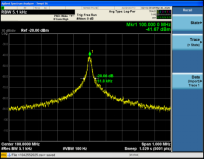


Figure 1. Frequency spectrum (typical linewidth < 3 kHz)
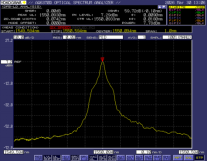
Figure 2. Optical spectrum (typical SMSR > 50 dB)
Leading Performance: Ultra-Narrow Linewidth and High Thermal Stability
A narrower linewidth provides higher coherence and lower phase noise. Litecore's external-cavity laser delivers a typical linewidth below 3 kHz. This performance results from precision optical-path design: the photon round-trip path is lengthened within the cavity, physically suppressing phase perturbations caused by spontaneous emission. The result is a narrow-linewidth source that moves beyond basic functionality toward a production-ready, platform-level domestic solution. The device supports wide-temperature operation from -5°C to 65°C. With precision TEC control, wavelength stability is better than ±1 pm, making it suitable for both laboratory instruments and outdoor cabinets despite temperature variation.
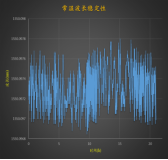
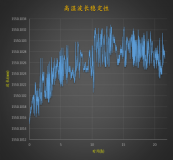
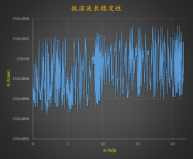
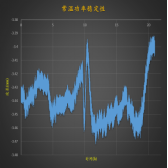
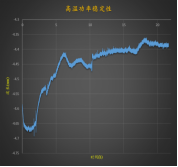
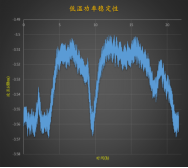
Figure 3. Wavelength and Output-Power Stability of the Ultra-Narrow-Linewidth Laser
Comprehensive Specifications: Full C-Band Coverage for Multiple Applications
Litecore's ECL narrow-linewidth laser is offered in an industry-standard 14-pin butterfly (BTF) package compatible with mainstream optical-module interfaces, enabling straightforward integration without additional redesign. It covers the entire C-band from 1530 to 1565 nm and aligns with the ITU-T wavelength grid. Key performance includes a linewidth below 3 kHz, a side-mode suppression ratio (SMSR) above 50 dB, and single-longitudinal-mode output power above 10 dBm. Litecore maintains end-to-end control from chip design and external-cavity packaging through volume manufacturing and delivery. Across quantum computing, coherent communications, LiDAR, fiber-optic sensing, and precision metrology, Litecore provides external-cavity narrow-linewidth lasers with low phase noise and high SMSR.
Narrow-linewidth lasers are the "heart" of optical communications and precision sensing. Litecore is one of the few domestic narrow-linewidth source suppliers with in-house laser-chip R&D capability. By tightly integrating its proprietary gain chip with external-cavity technology, Litecore has built a technology moat at the chip level. Combined with the market opportunity created by supply-chain localization, this approach reduces system vendors' dependence on imported high-end light sources and provides a secure, independently controlled core optical engine for domestic communications and sensing systems advancing toward higher frequencies and longer transmission distances.
-

-
光芯片及模块研发生产线建设项目竣工环境保护验收监测报告公示
넶2275 2023-04-04 -
中科光芯原材料采购招标邀请函
넶1670 2022-12-21 -
省科技厅与中科光芯党员联合开展主题党日活动
为迎接党的二十大,贯彻落实中央科技创新思想,8月18日下午,省科技厅周世举副厅长带领高新处、创新办、成果处相关领导一行莅临中科光芯,开展“红心向党迎盛会,科技创新永担当”主题党日活动。
넶1675 2022-08-20 -
Guo Xuejun, Deputy Director of Fujian Economic and Information Commission, visited our company for inspection and guidance.
Guo Xuejun, deputy director of Fujian Provincial Economic and Information Commission, accompanied by the main leading comrades of the Urban Economic and Information Commission, visited Fujian Zhongke Optical Core Optoelectronic Technology Co., Ltd. for inspection and guidance. Deputy Director Guo Xuejun wore purification factory clothing, went deep into the company's first-line production workshop, visited the country's first active optical chip micro-nano processing production line, and listene
넶1010 2020-02-16